
How to Choose and Match the Right Stationery Set
The right stationery set should be built around user age, daily tasks,
target market, price position, packaging format and replenishment needs.
B2B buyers should not simply combine the lowest-priced notebook, pencil,
eraser, ruler and sharpener. A practical wholesale stationery set needs
compatible quantities, suitable specifications, consistent colors, safe
components, efficient packaging and an achievable MOQ.
The following guide from BRT explains how to select a base configuration, add optional products, compare common specifications, control mixed-product risks and prepare a complete quotation request.
What Should Buyers Confirm Before Selecting Stationery Products?
Buyers should first confirm who will use the stationery set, where the stationery set will be sold and which tasks the products must support. Product selection should begin with the actual user scenario rather than the number of items shown on the packaging.
A school starter set, an office set, a promotional gift set and a retail stationery set require different combinations. A school project buyer may prioritize durability, uniform specifications and easy quantity checking. A retailer may place more importance on appearance, shelf display and perceived value. A corporate gift buyer may need stronger branding and more presentable packaging.
Buyers should confirm the following points before choosing individual products:
- Target user age
- School, office, art or promotional use
- Retail, wholesale, tender or donation channel
- Target selling price or project budget
- Required product quantity
- Preferred packaging format
- Logo and color requirements
- Taget country and applicable safety requirements
- Expected delivery schedule
- Shipping method and carton volume limitations
A stationery supplier cannot recommend an accurate combination when the RFQ only states "one school stationery set." The same description may refer to a five-item basic set, a complete classroom kit or a retail gift package.
Explore our wholesale stationery sets collection to find different configurations for schools, retailers, promotional projects and customized programs.
[View our Wholesale Stationery Sets →]
Which Products Should Form the Base Stationery Set?
A base stationery set should contain the products required for the main task. Optional products should only be added when the additional products improve usability, retail value or suitability for the target age group.
Different markets require different stationery combinations. Buyers can review our school stationery sets designed for different age groups and learning scenarios.
[Explore School Stationery Sets →]
A basic school writing set may include:
- Exercise book or notebook
- Pencil or pen
- Eraser
- Sharpener
- Ruler
- Pencil case or packaging bag
Additional products may include:
- Colored pencils
- Washable markers
- Highlighters
- Glue sticks
- Scissors
- Geometry tools
- Sticky note
- Correction products
- Craft paper
- Drawing materials
Adding more products does not automatically create a better stationery set. A set containing many low-use accessories may look attractive in a product image but provide limited practical value. The quantity of each product should match the expected usage period.
For example, several writing instruments may be useful when a set contains multiple exercise books. A large number of accessories combined with only one small notebook may create an unbalanced set. Buyers should evaluate the working relationship between the products rather than counting the total number of pieces.
How Should Stationery Sets Be Matched for Different Users?
Stationery set configurations should change according to user age, learning stage and daily activity. The exact products should also be checked against the target market's safety and school requirements.
| User Group | Recommended Product Direction | Important Buying Considerations |
|---|---|---|
| Preschool users | Drawing tools, easy-grip writing tools, simple activity books and easy-to-open storage | Small detachable parts, product dimensions, washable materials and market-specific safety requirements |
| Primary school students | Pencils, erasers, sharpeners, rulers, exercise books, colored pencils and pencil cases | Easy operation, durability, classroom use and replacement frequency |
| Secondary school students | Pens, mechanical pencils, highlighters, notebooks, correction products and geometry tools | Writing performance, subject requirements, storage capacity and product appearance |
| Office users | Ballpoint pens, gel pens, notebooks, sticky notes, file products and desk accessories | Professional appearance, reliable writing, branding area and daily efficiency |
| Promotional gift users | Branded notebooks, pens, folders and presentation packaging | Logo visibility, color consistency, presentation quality and budget |
| School project buyers | Standardized writing tools, notebooks and essential classroom accessories | Uniform specifications, quantity control, carton marking and delivery coordination |
Preschool stationery sets should not be selected only by color or cartoon design. Product dimensions, detachable components, material information and intended use require confirmation.
Secondary school sets should reflect the actual curriculum. Geometry tools may be useful for some projects but unnecessary for a general writing set. Office stationery sets should avoid adding child-oriented accessories unless the buyer is targeting a creative or casual office market.
How Can Buyers Balance Product Quality and Project Budget?
Buyers should establish a priority order before reducing specifications. Reducing the number of unnecessary products is often more effective than lowering the quality of every product in the stationery set.
A practical decision order may be:
- Protect the function of essential products.
- Remove accessories with limited use.
- Simplify packaging.
- Reduce complex printing or decoration.
- Adjust non-essential materials.
- Review carton volume and combination labor.
For a small market test, stock products with simple packaging may be more suitable than fully customized products. Custom color boxes, printed inserts and multiple logo processes can create additional setup costs and higher packaging minimums.
For a long-term retail program, customized packaging may support shelf recognition and brand consistency. The correct option depends on projected quantity, sales channel and repeat-order potential.
Which Packaging Format Is Suitable for a Stationery Set?
Packaging should be selected according to retail presentation, protection, packing labor and transportation volume.
| Packaging Option | Main Advantage | Main Limitation | Suitable Scenario |
|---|---|---|---|
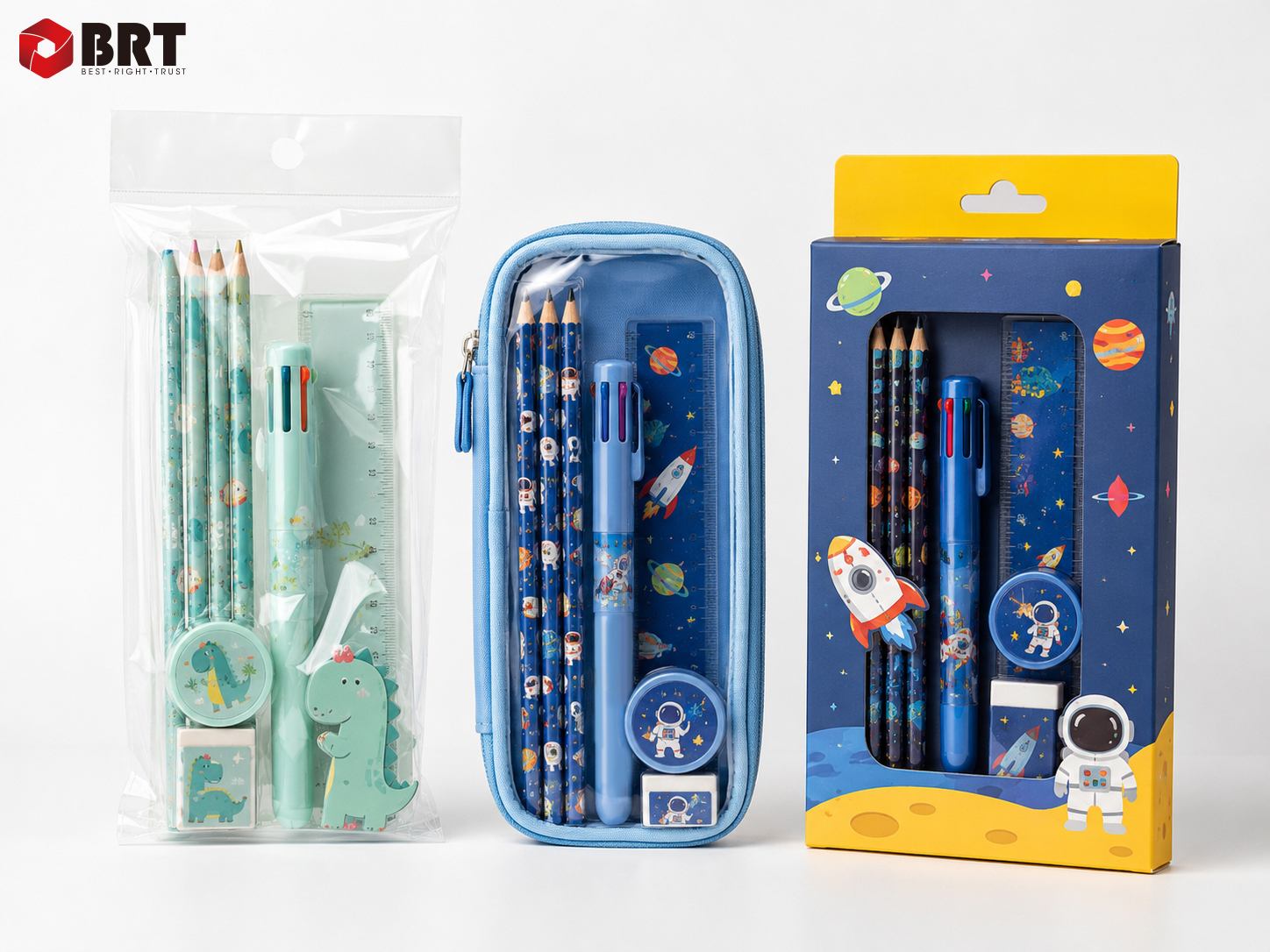
| OPP bag | Simple structure and relatively low packaging complexity | Limited protection and limited premium presentation | Basic school kits, donation projects and cost-sensitive orders |
| Blister card | Products can be displayed clearly | Packaging structure may require additional tooling or assembly | Retail accessories and visible product combinations |
| Display box | Supports shelf display and multiple-unit presentation | Display structure may increase carton volume | Retail stores and counter displays |
| Color box | Strong branding and complete product presentation | Printing setup, minimum quantity and box volume require confirmation | Branded retail sets and gift sets |
| Pencil case as packaging | Packaging can also become part of the product | Case size controls the number and arrangement of products | Student sets and reusable school kits |
Small trial orders do not always justify customized color boxes. Low quantities can result in a high packaging cost per set. A printed sticker, paper sleeve or standard bag may provide a more practical market-testing solution.
Buyers should also check whether the packaging increases unused space. A visually large color box may improve shelf presence but increase freight cost when the internal products occupy only a small part of the box.
What Determines the MOQ of a Custom Stationery Set?
The MOQ of a custom stationery set is usually controlled by the component or packaging option with the highest production minimum. The total number of finished sets does not automatically determine whether every customized item can be produced.
A stationery set may contain:
- Stock pencils
- Customized notebooks
- Printed pencil cases
- Standard erasers
- Custom color boxes
Each product can have a different minimum requirement. Printing plates, material colors, packaging structures and production processes may create separate MOQ restrictions.
Buyers should ask the supplier to separate the following information:
- MOQ for stock products
- MOQ for customized products
- MOQ for each logo process
- MOQ for custom colors
- MOQ for printed packaging
- Minimum quantity for mixed designs
- Minimum quantity for each individual SKU
A mixed stationery order can sometimes meet the total order value required by a supplier while failing to meet the production minimum for one customized component. The supplier should identify the controlling item before sample approval.
What Problems Commonly Appear in Mixed Stationery Orders?
Mixed stationery orders require more coordination than single-product orders because the products may come from different production sources and follow different schedules.
Common problems include:
Inconsistent Colors
A buyer may request the same blue color for notebooks, pencil cases, rulers and packaging. Different materials and printing processes can produce visibly different shades even when the same digital color reference is used.
Buyers should define whether exact color matching is necessary or whether a coordinated color family is acceptable.
Different Logo Results
Silk screen printing, hot foil stamping and UV printing can produce different visual effects. A logo that works well on a notebook cover may not produce the same result on a soft pencil case or curved pen barrel.
Logo artwork should be reviewed for each material rather than approved only once for the complete set.
Unbalanced Production Schedules
Notebooks, plastic products, textile pencil cases and printed packaging may have different production or sourcing schedules. One delayed item can prevent the complete set from being assembled and shipped.
The supplier should confirm the schedule of every key component before providing a final delivery plan.
Quantity Loss During Combination Packing
Separate products may be received in different packing quantities. Combination packing requires counting, sorting and repacking. Missing pieces or incorrect quantities can appear when the bill of materials is unclear.
Each set should have an approved item list showing the product name, specification, color and quantity.
Sample and Bulk Differences
A sample may be prepared from available stock while the bulk order uses customized materials or packaging. Buyers should clarify which sample details represent the final bulk standard and which details are only for reference.
What Common Mistakes Should Buyers Avoid?
Choosing Products Only by Appearance
Matching colors and attractive packaging cannot replace functional testing. Pens must write continuously, sharpeners must fit the selected pencils and erasers must work with the selected pencil grade.
Asking Only for the Unit Price
A low product quotation may exclude logo costs, printing setup, packaging, combination labor, inspection, carton changes or collection from multiple production sources.
Buyers should request a complete quotation structure.
Adding Too Many Products
A large piece count can increase packing labor, inspection complexity and carton volume. Every item should have a clear user purpose.
Ignoring Packaging Dimensions
Packaging can change the shipping cost of a stationery set. Buyers should compare carton dimensions, gross weight and loading efficiency rather than comparing only product prices.
Treating the Sample MOQ as the Bulk MOQ
A supplier may prepare one or several samples using available materials. Sample availability does not mean the same customization can be produced at a low bulk quantity.
Failing to Confirm the Target Age
A stationery set designed for older students may contain components unsuitable for younger users. Age suitability should be based on product structure, dimensions, usage method and applicable market requirements rather than design style alone.

How Should Buyers Inspect a Complete Stationery Set?
A stationery set inspection should confirm product function, appearance, quantity and packaging consistency.
1. Confirm the Approved Sample and Item List
The approved sample should be supported by a clear bill of materials. The item list should show:
- Product name
- Quantity per set
- Size or specification
- Material or model
- Color
- Logo position
- Packaging requirement
2. Check the Quantity of Every Component
Inspectors should verify the number of notebooks, pencils, pens, erasers and accessories inside each sampled set. The outside packaging should show an accurate content list when required.
3. Test Product Functions
Functional checks may include:
- Pencil sharpening
- Pencil lead strength
- Eraser performance
- Pen writing continuity
- Marker color and cap fit
- Ruler printing clarity
- Scissor opening and closing
- Pencil case zipper movement
- Notebook binding
- Glue stick operation
The final test items depend on the products included in the set.
4. Check Printing and Color
Inspectors should compare logo size, logo position, printing clarity and product color with the approved reference. Mixed-source products require special attention because color differences may appear across materials.
5. Check Packaging Integrity
Packaging inspection should confirm:
- Correct product arrangement
- Correct labels and barcodes
- Clean packaging
- Secure closure
- Accurate product count
- Suitable internal protection
- Correct carton marks
- Consistent carton packing quantity
6. Compare Sample and Bulk Specifications
The inspection should confirm whether bulk products match the approved material, dimensions, functions and packaging. A visual match alone is insufficient when product performance is important.
What Information Should Buyers Include in a Stationery Set RFQ?
A complete RFQ helps the supplier recommend a suitable product combination and prepare a comparable quotation.
Buyers should provide:
- Target market
- Target user age
- Intended use
- Estimated order quantity
- Required products
- Quantity of each product per set
- Preferred materials and specifications
- Target price range
- Logo artwork and logo process
- Product colors
- Packaging format
- Barcode and label requirements
- Compliance or testing requirements
- Delivery destination
- Shipping method
- Preferred trade terms
- Required delivery schedule
When the buyer has not finalized the product combination, the buyer can provide the target user, target selling price, sales channel and required number of products. A stationery supply chain partner can then propose several combinations for comparison.
NINGBO BRT IMP & EXP Co., Ltd., a professional stationery set manufacturer, can help buyers evaluate product combinations, packaging options, MOQ requirements and production plans.
Related News
- Print Finishing Techniques: Lamination, Foil, UV, Embossing & Die Cutting
- Paper Printing Methods: How B2B Buyers Can Choose the Right Printing Process
- How Should B2B Buyers Compare Packaging Costs for Cross-Border Stationery Orders
- Sewn, Spiral or Glue Binding: Which Notebook Construction Is Best?
- OEM vs ODM Stationery for Retail Brands: How to Choose the Right Sourcing Model
- Pencil Case Materials, Styles, Features Guide
Leave me a message