
How Should B2B Buyers Compare Packaging Costs for Cross-Border Stationery Orders
How Should B2B Buyers Compare Packaging Costs for Cross-Border Stationery OrdersBuyers should compare packaging cost for cross-border stationery orders by separating packaging materials, setup charges, packing labour and any agreed packaging inspection costs, then checking how each option changes shipment dimensions and freight. Use the same product specification, order quantity, currency, delivery terms and inspection scope for every quotation. A lower packaging price may exclude work or materials included elsewhere, but it may also reflect a different specification or production method. The useful comparison is therefore an itemised packaging cost per unit, followed by a separate check of the shipment cost under each packaging option.
What Should Buyers Confirm Before Comparing Packaging Quotes
Comparable quotations need a shared specification and a clear counting unit. Decide whether "one unit" means one notebook, one retail pack or one complete stationery set before comparing prices.
Confirm the product dimensions, contents per pack, order quantity, packaging purpose and delivery point. A bulk school supply order may need a different presentation from a branded gift set. Ask suppliers to list included costs, exclusions and assumptions, including whether packaging is already included in the product price.
For mixed sets, identify the source of each item and the party responsible for final assembly. Our business combines an owned paper stationery factory with full-range stationery sourcing: notebooks, exercise books, notepads and paper folders come from our own production, while nonpaper and complementary categories are supplied through audited partner factories. The packaging specification should cover the complete set across these production sources.
Browse our paper stationery range when selecting the products to include in a packaging quotation.
Which Costs Belong in a Stationery Packaging Quote
A packaging quote should separate the materials and work needed for the agreed order. Use the following categories as a comparison checklist; an individual order may not require every category.
| Cost category | What to request | What to clarify |
|---|---|---|
| Individual item packaging | Bags, paper bands, sleeves or other specified packs | Whether already included in the product price |
| Retail or set packaging | Boxes, header cards, trays, inserts or display packaging | Contents per pack and approved structure |
| Setup and tooling | Applicable print setup, cutting dies or stamping tools | Initial charge, reuse terms and change charges |
| Packing and assembly | Sorting, inserting items, assembling sets and applying labels | Which operations are included |
| Outer cartons | Specified cartons, dividers, liners and sealing materials | Carton specification and units per carton |
| Protective materials | Any agreed cushioning, corner protection or moisture protection | Required materials and placement |
| Labels and markings | Artwork, printing and label application | Buyer-approved content and responsibility for verification |
| Packaging checks and rework | Agreed inspection work and any separately quoted rework | Scope, charging basis and approval before extra work |
Record freight separately. Freight is a shipment expense affected by packaging, but the entire freight bill should not automatically be described as packaging cost. Market-specific label requirements also need confirmation for the actual product and destination.
For related reading on documentation for US-bound children's stationery, see our CPSC eFiling: CPC vs GCC guide.
How Can Buyers Calculate Packaging Cost Without Counting Charges Twice
Calculate packaging cost per unit from order-level amounts in the same currency. Count each charge once, and distinguish a total tooling charge from a tooling amount already spread across units.
Packaging cost per unit = Total packaging charges allocated to this order ÷ Number of agreed units in this order.
The numerator includes the applicable materials, tooling, labour and packaging checks listed above. If a supplier quotes a per-unit material price, multiply that price by the relevant quantity before adding it to order-level charges. If tooling is already included in that price, do not add it again. Identify any estimated allowance separately from a confirmed charge.
To compare two packaging options with the same products and quantity, use a second calculation:
Change in packaging and shipment cost per unit = [(Packaging total B − Packaging total A) + (Shipment total B − Shipment total A)] ÷ Order quantity.
Use shipment quotations covering the same route, service, delivery scope and quotation period. This comparison shows the combined change in packaging and shipment expense; it is not a calculation of full landed product cost. Add any other affected costs separately when relevant.
When Do Setup Charges Make Custom Packaging Expensive
A setup charge has a larger per-unit effect when the same charge is spread across fewer units. That comparison only holds when the design, process and tooling requirements remain unchanged.
Ask the supplier to distinguish existing packaging formats from structures or artwork requiring new setup. Confirm which charges apply to the first order, whether tools can be reused, who stores them and what changes or replacement conditions trigger another charge.
For a small trial order, request both a stock packaging option and a custom option. Custom packaging may still be justified if the trial must test retail presentation, but its setup cost should remain visible rather than being mistaken for the expected repeat-order cost. Confirm sample, artwork and production timing separately for each option.
Our sampling lead time is 2-7 working days, and bulk production takes 14-35 working days, excluding holidays. Confirm the applicable schedule and when each period starts for the selected product and packaging specification; these production periods should not be treated as a promised arrival date.
Available logo processes include gold and silver foil stamping, debossing, embossing, UV printing and screen printing. Confirm the suitable process for the selected product or packaging material during sampling rather than assuming every process is available on every surface.
Which Packaging Format Fits the Product and Selling Channel
Choose packaging by the required protection, presentation and handling conditions, then compare quotes for the actual specifications. The table below is a selection framework, not a universal ranking of price or performance.
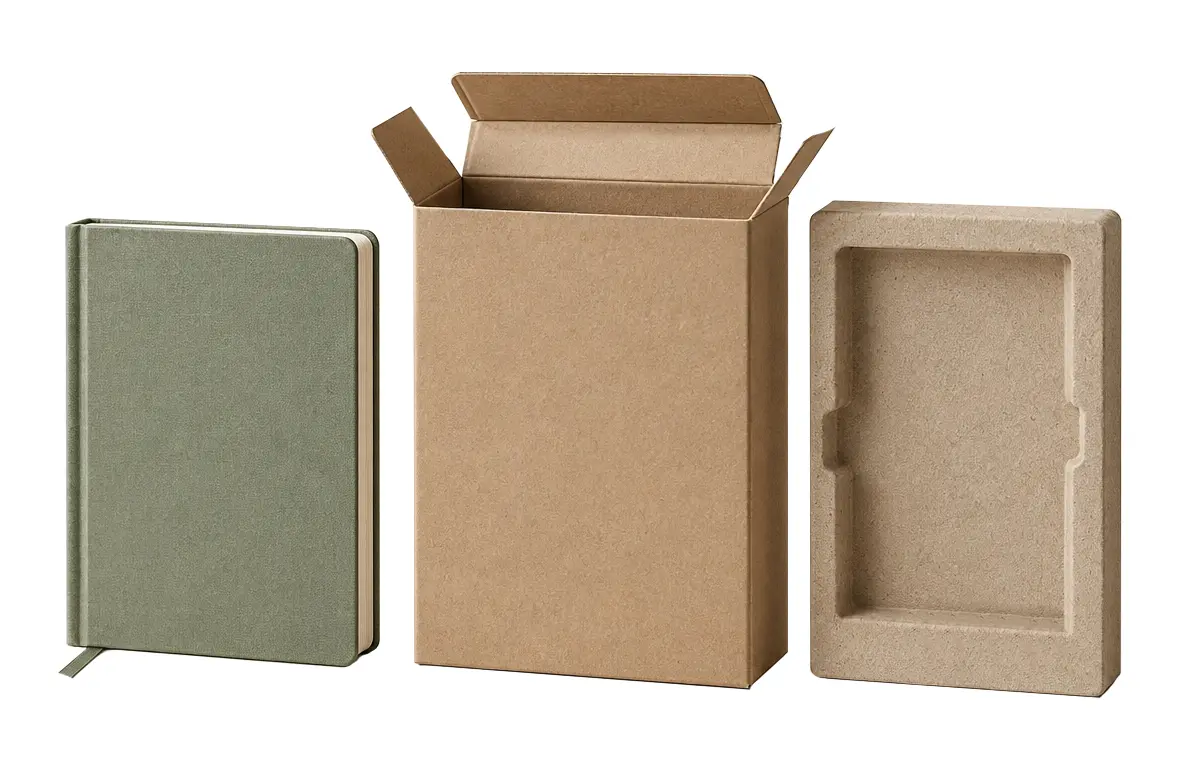
Packaging layers shown separately.
| Format | Potential use | Cost question | Limitation or check |
|---|---|---|---|
| Stock bag or paper band | Bulk supply or simple trial packs | Can an existing size be used without new print setup? | Confirm surface protection and support from the outer pack |
| Bag with printed header card | Products intended for hanging display | What card printing and attachment work is included? | Check hanging strength and label space |
| Blister with backing card | Visible display with a fitted product cavity | Is an existing cavity suitable or is new tooling required? | Check actual product fit, retention and pack opening |
| Printed folding carton | Branded retail packs or stationery sets | Which print, cutting and assembly charges apply? | Check internal fit and packed carton volume |
| Display box | Counter or shelf presentation | Is it delivered assembled or flat? | Confirm destination assembly work and loaded stability |
| Rigid box or tin | Presentation-led gift packs | Is the size standard or custom, and what insert is needed? | Compare weight, space, surface damage risk and trial quantity cost |
Do not select a thicker board or a heavier pack solely as a proxy for protection. Assess the complete structure with the intended contents and handling conditions. If dimensions, artwork or the sales channel are still unsettled, finalising custom tooling may create avoidable change costs.
For products such as a 3D cartoon dog hardcover notebook or a squeeze silicone notebook, ask the supplier to confirm the packed dimensions and clearance around the cover design before approving the box or insert.
How Should Buyers Check the Freight Effect of Packaging
Compare the packed shipment under each option, because a saving on packaging can be offset by higher shipment charges. Ask the supplier for external carton dimensions, carton quantities, units per carton, gross weight and any pallet dimensions.
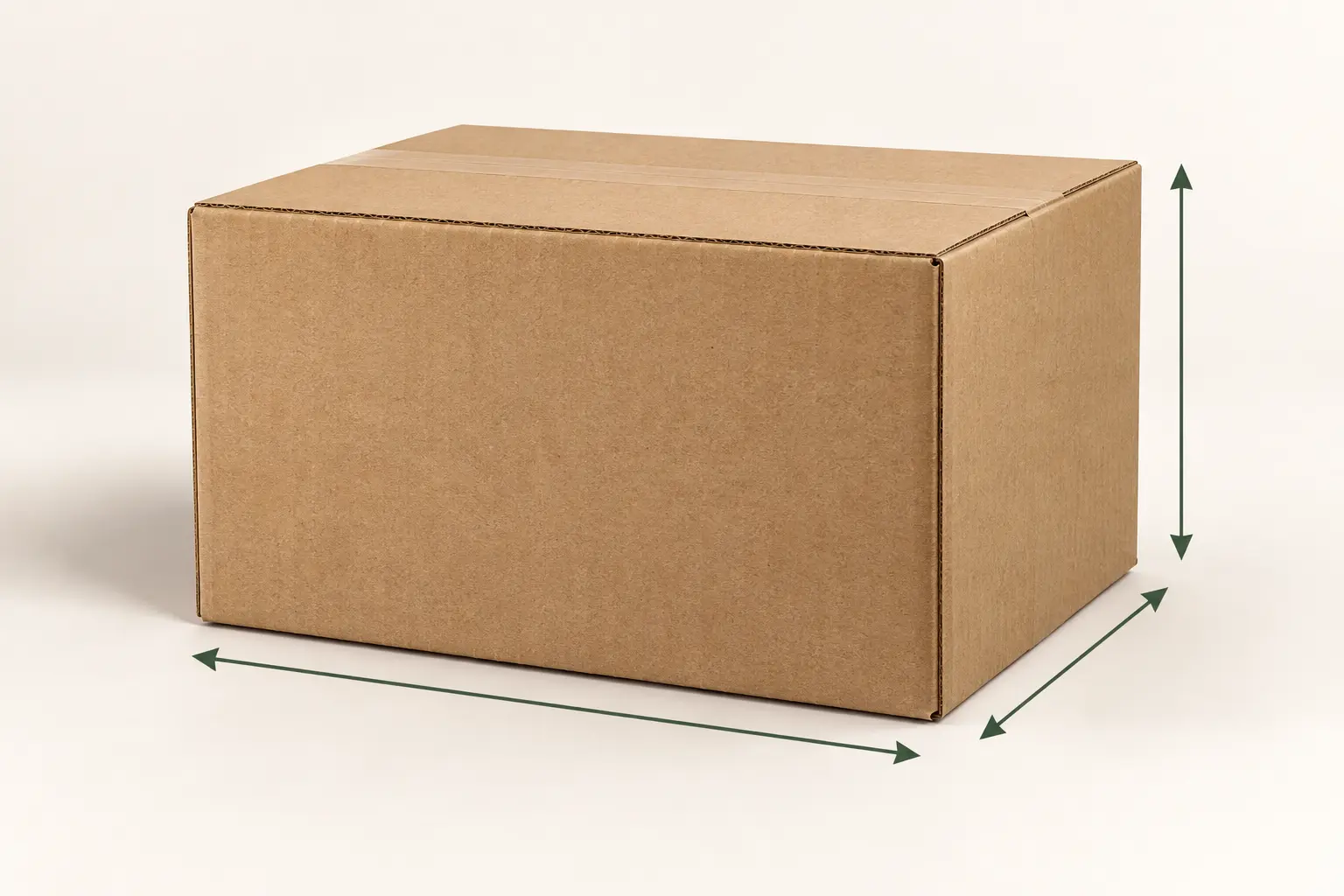
External carton dimensions to confirm when comparing shipment volume.
For a volume comparison, calculate each carton type separately:
Carton volume in cubic metres = External length in metres × External width in metres × External height in metres.
Multiply by the number of cartons of that type, then add the totals. Carton volume alone does not establish the carrier's chargeable volume or loading capacity; confirm pallet space, weight limits and the actual charging basis with the freight provider.
If packaging can be shipped flat, include destination assembly labour, equipment and handling in the comparison. A lower shipment volume does not establish a lower total cost unless those additional tasks are accounted for.
What Can Increase the Cost of Packing Mixed Stationery Sets
Mixed sets can require additional coordination when components have different quantities, arrival dates, dimensions or packaging requirements. Similar work can also occur in a single-source order, so buyers should request the actual operations rather than assume a fixed mixed-sourcing surcharge.
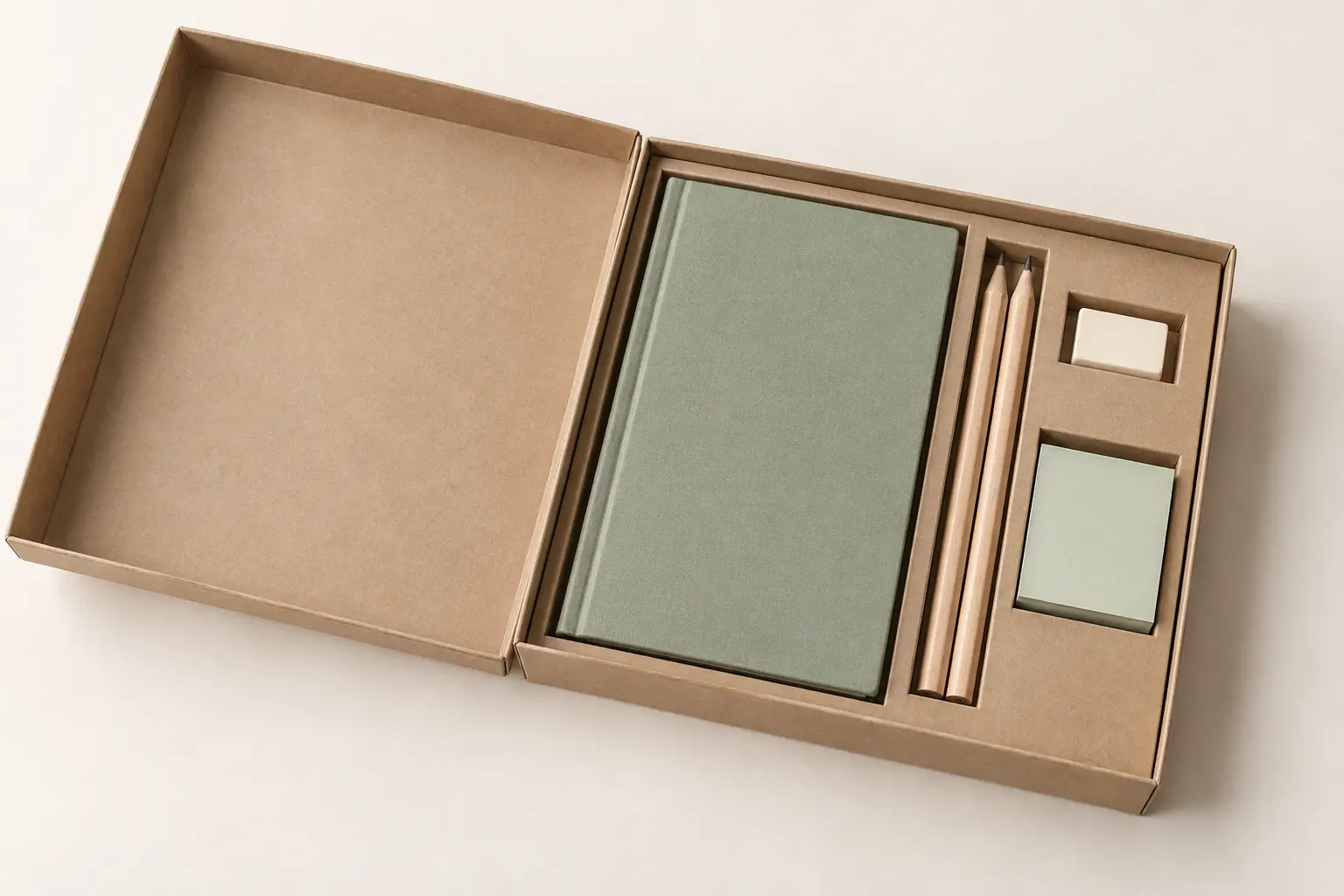
Compartment layout for a mixed stationery set.
Before approving the pack, confirm:
● The item list and quantity of each component per set.
● Each component's supply minimum and any packaging minimum.
● Whether stock components or agreed surplus inventory can resolve a minimum-quantity mismatch.
● The approved colour references and acceptable variation across different materials.
● The assembly location, incoming count checks and responsibility for shortages.
● The arrival schedule and agreed treatment of storage, sorting or repacking charges.
The highest component minimum may constrain the set quantity, but the relationship also depends on how many of that component each set uses and whether excess stock is acceptable. Assembly cost likewise depends on handling complexity and process, not just the number or selling price of the items.
Approve an assembled set before finalising the packaging. Individually acceptable components can still leave a pack difficult to close, permit movement inside it or create an incorrect item count.
How Should Buyers Inspect Packaging Before Shipment
Inspect the finished pack against an approved sample and a written specification that defines what is acceptable. Agree the inspection method and acceptance criteria before production; a general visual check is not a substitute for a specified performance test.
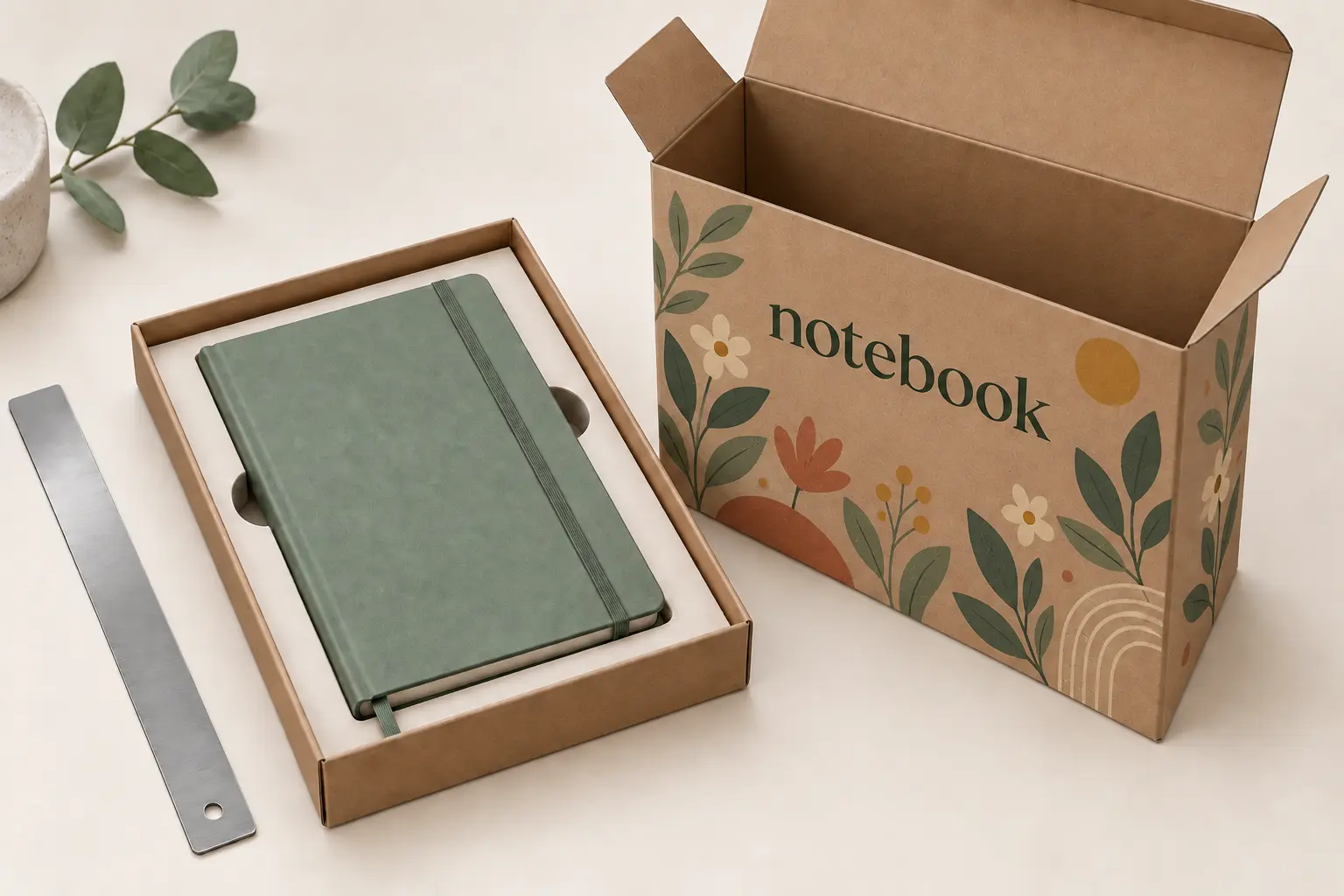
Packaging fit and corner details to inspect.
| Check | Practical action |
|---|---|
| Dimensions and materials | Measure the agreed pack and carton dimensions; compare material specifications with the order |
| Print and labels | Compare artwork version, colour reference, placement and approved wording |
| Barcode function | Check readability using the agreed receiving setup and verify the encoded item information |
| Fit and closure | Pack the actual contents; check inserts, closures and any movement inside |
| Set and carton quantities | Count components in selected sets and units in selected cartons according to the agreed sampling plan |
| Protection | Check specified cushioning, liners and other protective materials and their placement |
| Shipment performance | Carry out agreed drop, stacking or other checks using defined conditions and acceptance criteria |
| Identification | Match item codes, carton numbers and shipping marks to the approved packing information |
Use weight consistency as a supporting check, not as a replacement for confirming the contents. Record defects, agree corrective action and verify affected packs again before release. For mixed sets, inspect the assembled retail pack as well as individual items.
Which Quotation Mistakes Should Buyers Avoid
The most useful quotation review checks whether the offers describe the same deliverable. Pay particular attention to these mismatches:
● Comparing a price per item with a price per complete set.
● Adding tooling again after it has already been included in a unit price.
● Comparing an initial custom order with a repeat order using retained tooling.
● Approving artwork before pack dimensions and contents are settled.
● Accepting a material saving without checking carton dimensions and shipment charges.
● Treating sample approval as confirmation that every production pack meets the specification.
● Assuming an unspecified "delivery" price includes the same services in both offers.
What Other Questions Do Buyers Ask About Packaging Quotes
Can two different packaging designs still be compared
Yes, if the buyer first defines the minimum protection, presentation and handling requirements. Compare both designs against those requirements, then calculate packaging and shipment costs separately. Identical prices are not useful if the packs serve different purposes.
Does a lower MOQ necessarily mean a higher price
No. The price depends on the actual quantity, available packaging, setup requirements and production terms. Ask for comparable quantity breaks rather than treating the minimum order quantity as a price formula.
Are repeat-order printing plates free
Only if the supplier's agreed terms say so. Confirm storage, reuse, artwork changes, wear and replacement charges in writing before relying on a lower repeat-order cost.
Can items from different factories share one shipment
They may be consolidated when the goods, schedule, packing arrangements and shipment requirements allow it. Confirm the assembly point, availability of all components and responsibility for inspection and documentation before committing to a loading date.
Is a delivered quotation enough to compare suppliers
A delivered quotation helps only when the delivery point, included services and commercial terms are clear and comparable. Request the packaging breakdown as well, so a freight difference does not hide a packaging difference.
What Should Buyers Send to Request a Comparable Packaging Quote
Send a product list with dimensions and materials, quantities per item and per set, the total order quantity, and the intended sales channel. Include packaging references, logo files, approved label content, carton or pallet restrictions, the destination, requested delivery terms, inspection scope and required schedule.
Ask for separate packaging charges, shipment dimensions, exclusions and the conditions for repeat orders. Where a packaging decision remains open, request clearly specified alternatives. With those details, our paper stationery manufacturing and full-range sourcing team can review the own production paper items and partner-supplied accessories together and prepare a packaging proposal for the order.
Request a stationery quotation with the product and packaging requirements listed above.
Related News
- Print Finishing Techniques: Lamination, Foil, UV, Embossing & Die Cutting
- Paper Printing Methods: How B2B Buyers Can Choose the Right Printing Process
- Sewn, Spiral or Glue Binding: Which Notebook Construction Is Best?
- OEM vs ODM Stationery for Retail Brands: How to Choose the Right Sourcing Model
- Pencil Case Materials, Styles, Features Guide
- Back-to-School Stationery Sourcing Calendar for Retailers: When to Order for 2027
Leave me a message