
How to Choose the Right Paper Weight (GSM) for Notebook and Exercise Book Inner Pages

Choosing the correct paper weight is one of the most important decisions when developing notebooks, exercise books and school stationery products.
For global buyers, notebook paper GSM selection should consider more than paper thickness. Writing tools, target users, product positioning, production cost, shipping weight and market requirements all influence the final paper specification.
Most school exercise books and notebooks use 70 GSM or 80 GSM inner pages. Choose 70 GSM for cost-sensitive school programs and large-volume educational projects where pencil and ballpoint writing are the main applications. Choose 80 GSM when smoother writing performance, reduced show-through and improved product quality perception are required.
Premium notebooks, corporate notebooks and fountain-pen notebooks usually require 90-100 GSM paper because thicker paper provides better opacity and a more premium writing experience.
As an experienced notebook supplier and exercise book manufacturer, we help global buyers select suitable paper specifications according to market positioning, product requirements and budget targets.
Explore our notebook collection →
| Paper GSM | Recommended Application | Main Advantage |
|---|---|---|
| 70 GSM | School exercise books, bulk stationery programs | Lower cost and lighter shipping weight |
| 80 GSM | Standard notebooks, office notebooks | Better writing feel and reduced show-through |
| 90 GSM | Premium notebooks, branded notebooks | Higher quality perception |
| 100 GSM | Fountain pen notebooks, gift notebooks | Excellent opacity and premium experience |

What Does Paper Weight (GSM) Actually Measure?
GSM stands for grams per square metre - the weight of one square metre of paper. It is the standard international measure of paper density, not thickness. A 70 GSM sheet and an 80 GSM sheet of the same size differ in weight by about 14%, which is the main reason material cost and finished-book weight change when GSM changes.
GSM is not the same as caliper (thickness in micrometres). Paper "bulk" - how thick a sheet feels per gram - varies by mill and grade. Two papers both labelled 80 GSM can feel different in the hand and behave differently in binding. Buyers should therefore confirm both the GSM number and a physical sample, rather than trusting the GSM label alone.
Which GSM Should Be Used for School Exercise Books?
For school exercise books and bulk stationery programs, 70 GSM and 80 GSM are the most commonly selected paper specifications.
A professional exercise book manufacturer should recommend paper grades according to the project requirements instead of simply choosing higher GSM paper.
- 70 GSM paper is suitable for school exercise books, government education projects, donation programs and large-volume stationery orders because 70 GSM paper provides lower material cost and lighter shipping weight.
- 80 GSM paper provides smoother writing performance, better opacity and improved product appearance. 80 GSM paper is suitable for retail notebooks, brand school supplies and premium school programs.
A common mistake is specifying 80 GSM for a price-sensitive tender and then finding the unit cost no longer fits the budget. For large-scale school projects, 70 GSM is usually the rational baseline unless the buyer's brand or writing-tool mix demands more.
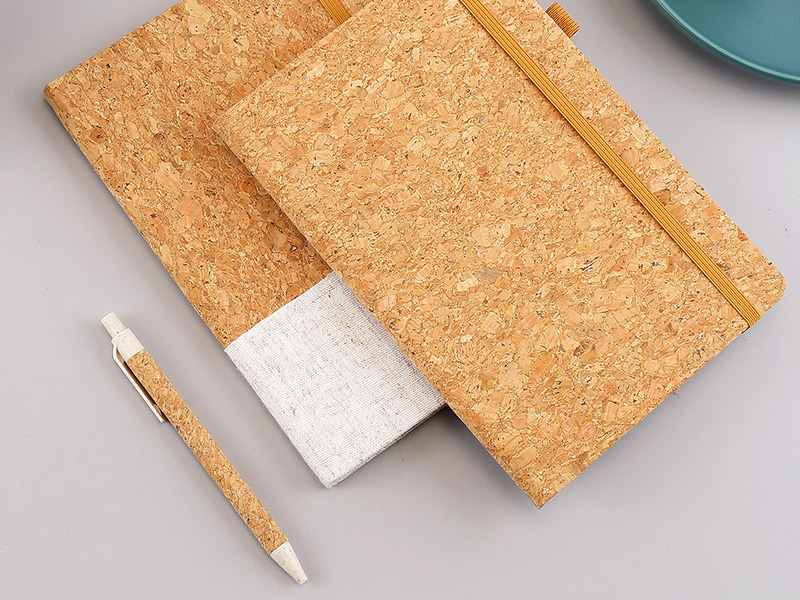
A typical school-style product using this approach is the Kraft Paper Eco Friendly Composition Notebook, which pairs an economical inner-page grade with a kraft cover for bulk education programs.
Which GSM Works Best for Premium Notebooks and Fountain Pens?
90-100 GSM is the practical range for premium notebooks and fountain-pen or marker use. At these weights, show-through and bleed-through drop sharply, and the page feels substantial.
- 90 GSM is a good middle ground for premium branded notebooks used with gel and roller pens.
- 100 GSM is preferred where fountain pens or highlighter-heavy note-taking are expected, or where the book itself is a gift or corporate item.
Buyers should not jump to 100 GSM by default. Heavier paper increases both material cost and shipping weight, and very thick inner pages can make a book feel stiff or increase its spine thickness beyond the planned cover size. The upgrade is justified when writing experience or brand positioning is the priority, not when the goal is lowest cost.
A leather-covered business notebook such as the Business Leather Notebook is a common application of 90-100 GSM inner pages where a premium writing impression matters.

How Does GSM Affect Material Cost and Shipping Weight?
Material cost rises roughly in proportion to the GSM increase, and finished-book weight rises with it, which directly affects sea freight calculated by weight. Moving inner pages from 70 GSM to 100 GSM increases the paper content per book by about 43% before any change in cover, binding or printing.
The freight effect depends on the shipping method:
- FCL (full container load): weight rarely blocks the shipment, but heavier books mean fewer units per container by weight, so the landed cost per unit still rises.
- LCL (less than container load): cost is usually charged on volume weight or actual weight, whichever is higher, so heavier paper can push the charge up noticeably on small trial orders.
Buyers comparing two quotations should check whether both quotes use the same GSM. A low quote may simply be a lighter paper, which is not a like-for-like comparison.
How Does GSM Affect Show-Through, Smoothness and Writing Feel?
Show-through (writing visible from the back of the page) and bleed-through increase as GSM falls. The risk is low with pencil and ballpoint at 70-80 GSM, but becomes visible with markers and fountain pens at 70 GSM.
Smoothness also changes with grade, not only GSM. A well-finished 80 GSM paper can feel smoother than a coarse 100 GSM paper. For pen glide and reduced ink spread, buyers should test the actual grade, not assume higher GSM automatically means better feel.
A practical test: write with the intended pen on a sample, then hold the page to the light and check the reverse side. If show-through is unacceptable for the target use, move up one GSM step rather than changing the whole specification blindly.
What Supply Chain Issues Appear When Changing Paper GSM?
Changing GSM is not just a spec line - it can trigger paper sourcing, consistency and production adjustments that affect cost and lead time.
- Paper-mill minimums: standard 70/80 GSM are usually stock grades; a non-standard weight may require a dedicated mill order with a higher minimum, raising MOQ or adding a surcharge.
- Shade consistency: whiteness and shade can vary between paper lots. For a bulk run, the buyer should confirm the supplier will hold one lot or match shade across lots, otherwise pages in the same book may differ.
- Sample vs bulk shade: samples are sometimes made from cleaner leftover stock; the bulk lot may be a slightly different shade. Request that bulk uses the same paper lot as the approved sample.
- Printing and binding: very thin paper can curl or jam in high-speed printing; very thick paper may need binding adjustment. Confirm the line can run the chosen GSM before committing. Different bindings also handle GSM differently - for example, the A5 Kraft Paper Cover Saddle Stitched Binding Notebook and the A5 Eco-Friendly Spiral Kraft Cover Notebook represent two binding approaches a buyer may compare for the same paper grade.
How Should Buyers Check Paper Quality in Samples and Bulk?
Use a short, repeatable checklist so the approved sample and the bulk delivery are judged on the same basis:
- Verify GSM: weigh a known area (e.g., 10 sheets of A4) and calculate, or use a GSM tester; do not rely on the label.
- Show-through test: write with the target pen and inspect the reverse side under light.
- Shade check: compare multiple copies from the same sample batch and, later, against the bulk lot.
- Smoothness: run a pen across the page; note any drag or feathering.
- Binding fit: confirm the chosen GSM does not change the book's thickness beyond the planned cover and spine.
- Lot record: ask the supplier to record the paper lot number for the bulk run so any future claim is traceable.

What Information Should Buyers Include in an RFQ for Notebook Paper?
A complete RFQ lets the sourcing partner recommend the right GSM instead of guessing. Include:
- Estimated quantity and whether it is a single item or a mixed set
- Page size and number of pages
- Target GSM, or a note allowing the supplier to recommend one
- Intended writing tools (pencil, ballpoint, gel, fountain pen, marker)
- Cover material and binding type (stapled, sewn, spiral, glued)
- Printing requirements (cover and inner-page printing)
- Packaging format (OPP bag, shrink wrap, display box, color box)
- Destination port and incoterms (FOB, CIF, DDP, etc.)
With this information, the supplier can prepare a comparable quotation and flag where a GSM change would save cost or prevent a quality issue.
Custom notebook projects require confirmation of GSM, cover material, binding method and packaging before production.
Comparison Table: 70 / 80 / 90 / 100 GSM Notebook Inner Pages
| GSM | Typical use | Relative thickness | Show-through (ballpoint) | Show-through (marker / fountain) | Relative material cost | Relative shipping weight |
|---|---|---|---|---|---|---|
| 70 | School exercise books, bulk stationery | Thin | Low-Medium | High | Low | Low |
| 80 | Standard & premium notebooks, office | Medium | Low | Medium | Medium | Medium |
| 90 | Premium notebooks | Medium-High | Very Low | Low-Medium | Medium-High | Medium-High |
| 100 | Premium / fountain-pen notebooks, inserts | High | Very Low | Low | High | High |
Cost and weight columns are relative indicators. Exact figures depend on grade, order quantity, packaging and destination freight, and should be confirmed in the quotation.
Common Procurement Mistakes
- Asking only for unit price without stating GSM: two quotes at different GSM are not comparable.
- Assuming 80 GSM feels the same from every supplier: bulk/caliper differs by grade; always judge a physical sample.
- Ignoring shipping weight: heavier paper raises freight, especially on LCL trial orders.
- Not fixing the paper lot: shade can vary between lots and make bulk pages look inconsistent.
- Specifying 100 GSM by default: it adds cost and weight that a school or bulk program may not need.
- Approving a sample from one lot, then receiving another: require the bulk to match the approved sample lot.
- Overlooking writing-tool fit: a low GSM that is fine for pencil may fail with markers or fountain pens.
FAQ
Is 70 GSM paper too thin for notebooks?
For pencil and ballpoint use in school exercise books, 70 GSM is the standard and economical choice. It becomes a problem only with markers, highlighters or fountain pens, where show-through increases.
Should I always choose 80 GSM over 70 GSM?
Not always. 80 GSM gives a smoother feel and less show-through, but costs more and weighs more. For large, price-sensitive school programs, 70 GSM is usually the better baseline.
Does higher GSM mean better quality?
Higher GSM means thicker and usually more opaque paper, but smoothness and shade depend on grade, not GSM alone. A good 80 GSM can outperform a poor 100 GSM for writing feel.
Will changing GSM change my shipping cost?
Yes, if freight is charged by weight or volume weight. Heavier inner pages increase finished-book weight, which can reduce units per container or raise LCL charges.
Can I mix 70 GSM and 100 GSM pages in one notebook?
Yes, for inserts or divider sections, but confirm binding can handle the mixed thickness and that the bulk lot is consistent for each section.
Request a Notebook Paper GSM Recommendation
Selecting the correct GSM specification can help buyers balance:
- Product quality
- Target market requirements
- Production cost
- Shipping efficiency
Provide the following information:
- Notebook size
- Page number
- Intended writing tools
- Target market
- Order quantity
- Cover material
- Binding method
- Packaging requirements
Our team can recommend suitable paper specifications, prepare comparable quotations and help buyers develop reliable notebook products.
Related News
- Print Finishing Techniques: Lamination, Foil, UV, Embossing & Die Cutting
- Paper Printing Methods: How B2B Buyers Can Choose the Right Printing Process
- How Should B2B Buyers Compare Packaging Costs for Cross-Border Stationery Orders
- Sewn, Spiral or Glue Binding: Which Notebook Construction Is Best?
- OEM vs ODM Stationery for Retail Brands: How to Choose the Right Sourcing Model
- Pencil Case Materials, Styles, Features Guide
Leave me a message