
Back-to-School Stationery Sourcing Calendar for Retailers: When to Order for 2027
Retailers targeting a June or July 2027 back-to-school launch should normally begin product and demand planning in September--October 2026, issue comparable RFQs by November, and aim to approve final samples, packaging, and compliance requirements before Lunar New Year production constraints affect the schedule. The exact order date depends on assortment complexity, customization, testing, production source, shipping mode, and the required warehouse date. A mixed private-label program needs more calendar protection than a repeat order using stock products and stock packaging.
The key sourcing decision is therefore not a single universal "order by" date. Retailers should set a required warehouse date, reserve time for receiving and allocation, and then work backward through ocean freight, production, testing, packaging approval, samples, RFQs, and assortment planning.

A 2027 back-to-school sourcing calendar should be planned backward from the required warehouse date.
What Does Circana's Back-to-School Retail Data Mean for 2027 Buyers?
Circana's data supports a two-part inventory strategy: secure core school-list items before the main selling window, but preserve a controlled replenishment option for demand that develops later.
U.S. office-supplies retail revenue reached $1.98 billion during the first six weeks of the 2025 back-to-school season, from June 29 through August 9, a 2% decrease from the comparable 2024 period. Circana described a slow start and shifts in purchase behavior. In August 2024, however, office-supplies unit sales increased 4%, even as consumers emphasized value and need-based purchases. Together, those results warn against treating the season as one large, predictable pre-season purchase.
Category selection also needs evidence rather than habit. Circana's 2026 review says index cards and loose-leaf paper each declined 3% in dollar sales in the prior season, while calculators also fell 3%. A decline does not mean retailers should remove those products automatically; it means the forecast should be checked against local school lists, prior sell-through, price points, and channel-specific demand before quantities are repeated.
Buyers can also review BRT-Stationery's 2026 stationery trends for retail buyers when developing the initial assortment.
When Should Retailers Start Trend and Product Planning?
For a June--July 2027 launch, a practical planning window begins in September--October 2026. This is a planning allowance, not a promised supplier lead time.
Start by separating the range into three demand groups. BRT-Stationery's wholesale school supplies for students and classrooms page can help buyers map core classroom products and complementary categories before sending the RFQ:
1. Core list products: exercise books, composition books, pencils, pens, erasers, rulers, glue, folders, and other items repeatedly found on school lists.
2. Retail differentiators: coordinated color stories, licensed or original graphics, themed stationery sets, display-ready packs, and retailer-exclusive specifications.
3. Test items: trend-led designs or price points that should receive a smaller initial allocation and a defined replenishment rule.
The assortment should also be divided by execution route. Repeat paper products with established specifications are easier to schedule than a new mixed set containing notebooks, writing instruments, accessories, a custom retail box, and components from several production sources. Trend selection is only complete when every proposed item has a target retail price, forecast quantity, packaging route, compliance market, and required warehouse date.
When Should Buyers Send the RFQ?
Retailers should target October--November 2026 for a structured RFQ if samples and final costing must be completed before the year-end and Lunar New Year planning period. The window is an illustrative reverse-planning allowance and must be recalculated against the selected specification.
A comparable stationery RFQ should state:
● item name and estimated quantity by SKU;
● dimensions, material, paper weight, page count, ruling, color, or writing specification as applicable;
● logo and artwork requirements;
● stock packaging or custom packaging;
● barcode, warning, labeling, and carton-mark requirements;
● target market and intended age group;
● required testing or document list;
● destination, trade term, and required warehouse date;
● whether split deliveries or replenishment are required.
Do not compare quotations when one price includes a printed display box, testing, consolidation, and inspection while another includes only the product in an OPP bag. Unit price is meaningful only after packaging, tooling or printing charges, test responsibility, master-carton configuration, and delivery terms are aligned.
When Should Samples Be Confirmed?
Retailers should reserve November--December 2026 for sample development and approval when the program includes new graphics, specifications, or mixed products. Exact timing depends on the number of revisions, material availability, printing method, and whether the sample is handmade or produced using bulk-production tooling.
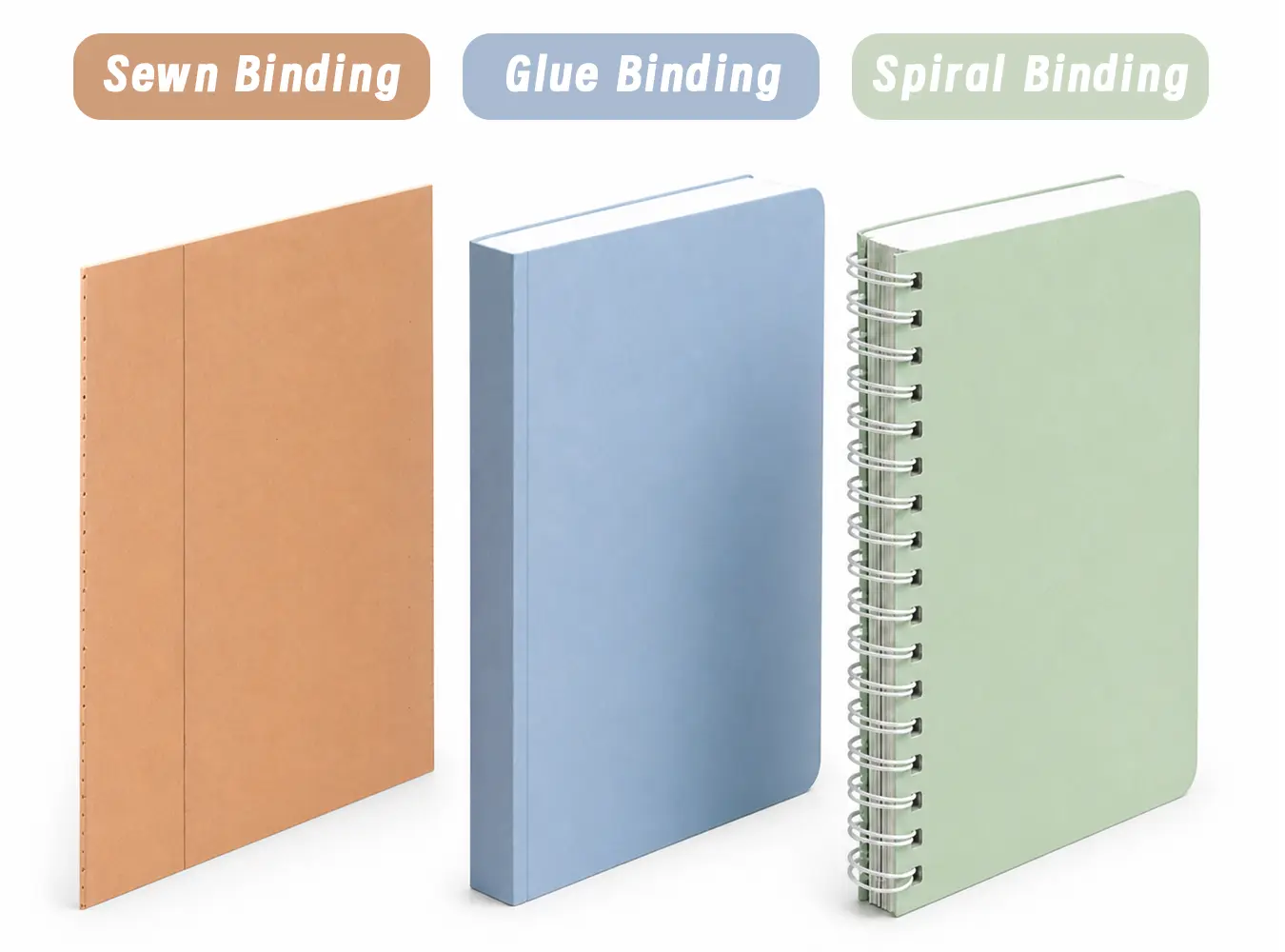
Approval should be recorded in a signed specification sheet rather than in scattered email comments. For a notebook, the approval record may include finished size, cover material, inner-paper specification, page count, ruling, binding, print colors, logo position, and packing method. For a mixed stationery set, buyers should confirm each component separately and then approve the assembled set.
A visual sample is not always a production-equivalent sample. Digital printing may be useful for checking layout, but it may not reproduce the color, surface, or registration of the final bulk-printing method. Retailers should label which attributes are approved and which remain subject to the production process. The 2026-2027 A5 spiral planner notebook illustrates the specification fields buyers should confirm for a paper product, including size, binding, cover, page layout, customization, stock status, and packaging.
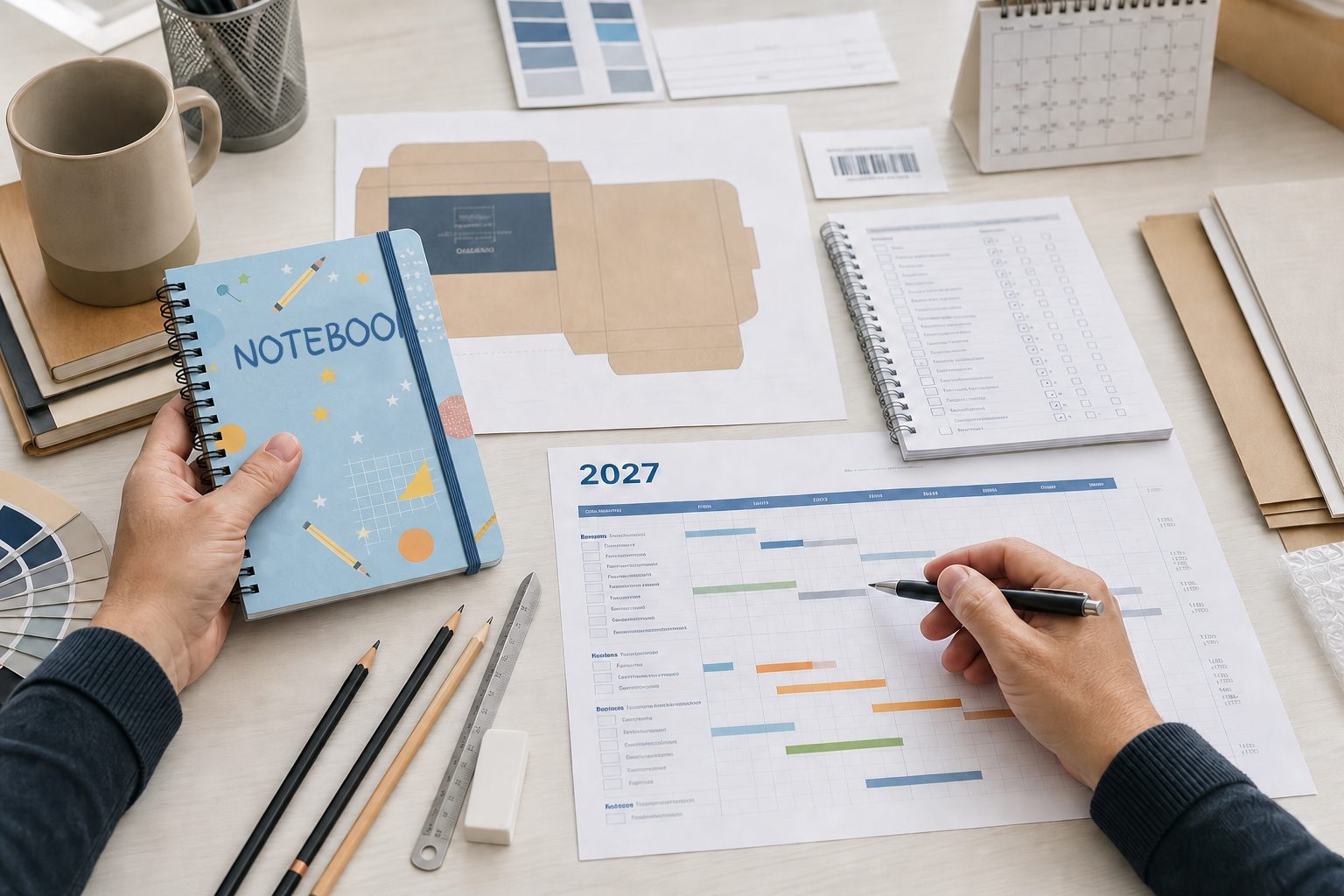
Sample approval should connect the product specification, packaging artwork and production schedule.
When Must Packaging Design Be Locked?
Custom packaging should ideally be approved with, or immediately after, the final product sample---not after bulk goods are complete. For this calendar, retailers should plan to lock packaging in December 2026--January 2027, subject to the actual structure and revision count.
Packaging affects more than shelf appearance. It can change the item MOQ, assembly labor, carton quantity, gross weight, shipping volume, barcode placement, warnings, and testing scope. A display-ready box may support merchandising but create more transport volume than a compact stock pack. A low-volume market test may therefore be better served by stock packaging plus a compliant label rather than a fully customized color box.
Before approval, check the dieline, product orientation, barcode scan area, country-of-origin marking, legal text, color references, inner quantity, master-carton quantity, and whether the pack survives stacking and handling. Changes to materials, coatings, inks, adhesives, or components can also affect the compliance assessment.
When Should Safety Testing Be Scheduled?
Compliance requirements should be identified at RFQ stage, while final testing should be scheduled against a production-representative sample and completed early enough to correct a failure without missing the shipment window.
For the United States, a product designed or intended primarily for children aged 12 or younger may be a children's product. Applicable requirements depend on product type, age grading, use, and material composition. The U.S. importer of an overseas-manufactured regulated children's product is responsible for issuing the applicable Children's Product Certificate based on results from a CPSC-accepted third-party laboratory; the importer cannot treat a laboratory report as a substitute for its own certification responsibility. Beginning July 8, 2026, importers of most regulated consumer products are also required to electronically file certificate data under the CPSC eFiling program.
Testing should not be reduced to "CPC required: yes/no." The buyer should define the destination, age grade, product function, materials, surface coatings, and applicable rules, then confirm the laboratory's accreditation scope. A material or component change after testing may require a new compliance review and, where applicable, retesting.
When Should Bulk Production Begin?
The bulk-production slot should be confirmed only after the buyer has frozen the product specification, packaging files, compliance plan, quantities, delivery terms, and approved sample status. BRT-Stationery's confirmed combined execution cycle ranges from 15 days for simple light customization to 45 days for complex personalized customization. The applicable period must be confirmed by SKU, packaging route, order quantity, and approval status, and the quotation must define whether days are calendar or working days. Under this illustrative calendar, production planning falls in January--March 2027.
The critical path for a mixed order is usually the slowest item or the packaging component with the latest approval---not the average lead time across all products. One late pencil-case color, retail-box insert, or test report can hold an otherwise completed stationery set.
Retailers should require a production control sheet that links every SKU to its approved version. Useful checks include dimensions, color, print position, page count, ruling, writing or erasing function, component count, packaging completeness, barcode, inner quantity, carton quantity, and carton marks. For paper stationery, bulk checks should also compare cover and inner-page construction with the approved specification. For writing instruments and accessories, functional checks should be defined for the actual product rather than assumed from appearance.
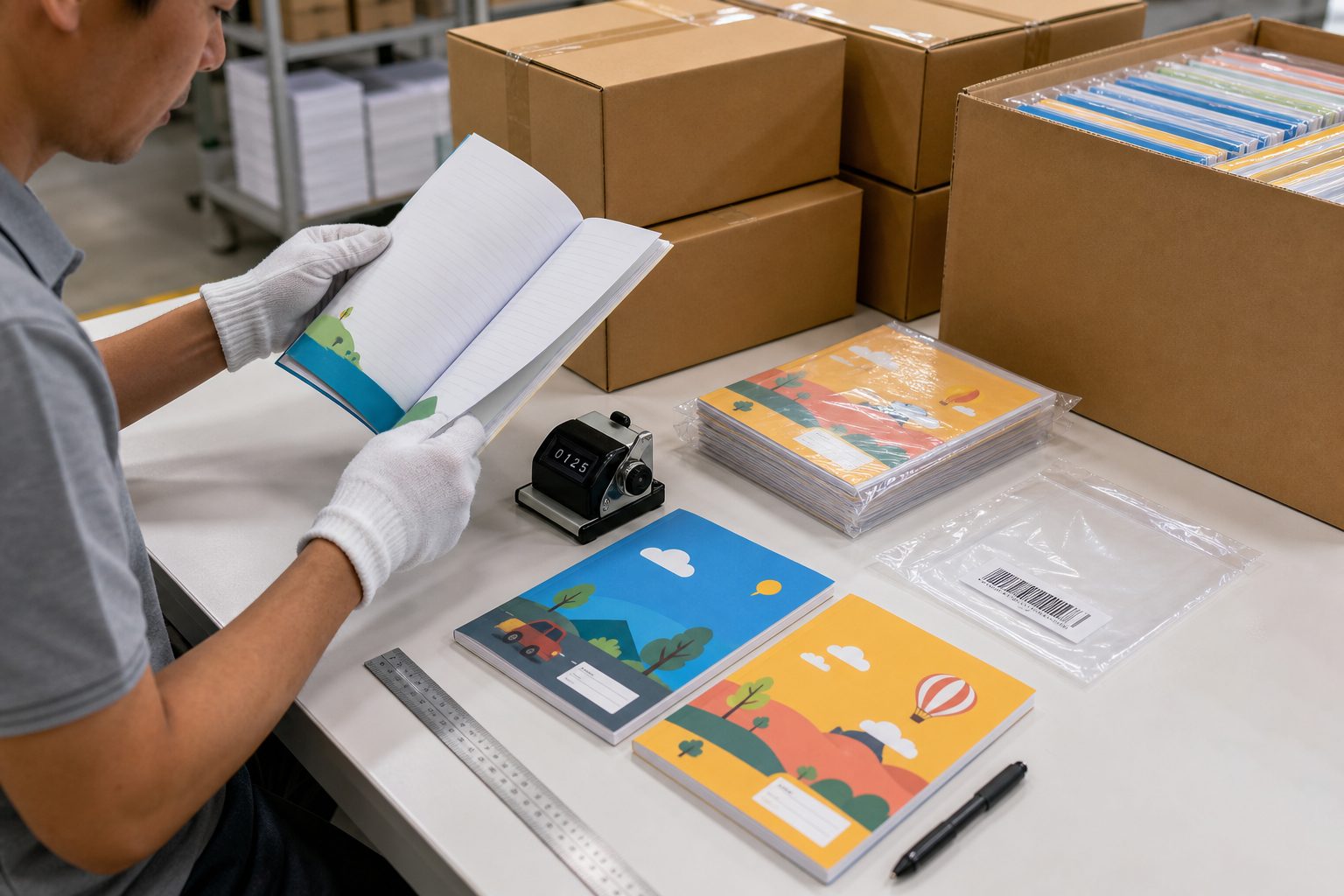
Pre-shipment inspection should verify notebook printing, page count, binding and packaging completeness.
How Much Time Should Buyers Allow for Ocean Freight and Warehouse Delivery?
Retailers should obtain a live logistics schedule from the nominated forwarder and add receiving contingency; a generic port-to-port estimate is not a warehouse-delivery promise.
Ocean planning must include more than sailing time:
● cargo-ready date and booking availability;
● origin pickup, consolidation, and export handling;
● port cut-off and vessel departure;
● transshipment risk where applicable;
● destination customs clearance and examination risk;
● port or rail dwell time;
● delivery appointment, unloading, receiving inspection, and system availability.
For a June--July shelf launch, the purchase order should specify an arrival-at-warehouse date, not only an estimated vessel departure date. High humidity, heat, compression, and long storage can affect paper products, printed packaging, adhesives, and metal components. Carton strength, moisture protection, pallet rules, container loading, and container utilization should therefore be reviewed before shipment.
What Is the Recommended 2027 Back-to-School Order Calendar?
The following schedule is an illustrative planning model for a customized assortment intended to reach a retailer's warehouse before a June--July 2027 launch. It is not a quotation or a guaranteed BRT-Stationery lead time.
| Planning window | Buyer decision | Required output | Main risk if delayed |
|---|---|---|---|
| Sep--Oct 2026 | Review sales, school lists, trends, target prices, and SKU roles | Assortment brief and required warehouse date | Forecast built from last year's quantities without checking current demand |
| Oct--Nov 2026 | Issue a standardized RFQ | Comparable specification and cost breakdown | Quotes exclude different packaging, testing, or logistics items |
| Nov--Dec 2026 | Develop and revise samples | Signed sample and specification record | Visual sample mistaken for production-equivalent approval |
| Dec 2026--Jan 2027 | Freeze artwork and packaging | Approved dielines, labels, barcodes, carton plan | Packaging holds finished goods or increases freight volume unexpectedly |
| RFQ onward; final sample before bulk | Confirm applicable safety and labeling requirements | Compliance matrix and test plan | Wrong test scope, late failure, or material-change retest |
| Jan--Mar 2027* | Reserve capacity and complete bulk production | Finished goods against approved standard | Slowest component delays the complete set |
| Apr--May 2027* | Inspect, consolidate, book, and ship | Passed inspection and complete shipment documents | Booking, transshipment, clearance, or document delay |
| May--Jun 2027* | Receive, inspect, allocate, and replenish stores | Available inventory by channel and location | Goods arrive at port but miss the retail allocation date |
| Jul--Sep 2027 | Execute controlled replenishment | Reorder or transfer decisions based on sell-through | Core items stock out while weak trend items are overstocked |
*These are planning placeholders. Exact dates depend on approved specifications, production source, order quantity, packaging, testing, route, destination, and supplier/forwarder confirmation.
How Should Retailers Plan Replenishment?
Replenishment should be designed before the opening order is placed. A retailer cannot assume that a customized SKU can be reproduced quickly after sales data appears.
Assign each item one of three rules:
● Pre-season commitment: Use for essential school-list products where a stockout would damage the range.
● Replenishment candidate: Use where materials or stock packaging can be reserved and a repeat specification is stable.
● One-season buy: Use for dated, highly customized, or trend-led packaging with limited post-season value.
Reorder logic should consider sell-through, weeks of cover, remaining selling weeks, inbound inventory, supplier readiness, and the risk of post-season markdown. Retailers should also decide whether replenishment must match the original packaging exactly or whether a stock-pack alternative is acceptable. Air freight may rescue a small shortage, but it should not be treated as the default solution for bulky, low-unit-value stationery.
What Common Scheduling Mistakes Put the Season at Risk?
The most common calendar failures occur at the handoffs between product, packaging, compliance, production, and logistics.
● Starting with the ship date instead of the warehouse date: Port arrival does not mean stock is available for stores or e-commerce fulfillment.
● Approving the product but not the pack: Bulk goods can wait while dielines, labels, barcodes, or display structures are revised.
● Testing an obsolete version: A later change in ink, coating, plastic, metal, adhesive, or component source may trigger a new compliance review.
● Treating a mixed order as one production line: Different items may have different material, packaging, MOQ, and completion constraints.
● Comparing only unit prices: Printing plates, dies, custom samples, assembly, consolidation, inspection, and carton volume can change landed cost.
● Ordering the entire forecast in one wave: Circana's recent data shows value-conscious and shifting purchase behavior, making controlled replenishment useful where the supply route permits it.
What Should Buyers Ask BRT-Stationery to Confirm?
BRT-Stationery should confirm the calendar at SKU level, because paper stationery production and full-range stationery sourcing are not the same execution route.
BRT-Stationery operates its own paper stationery factory for confirmed paper categories such as notebooks, exercise books, sticky notes, and paper folders. For non-paper stationery and complementary categories, BRT-Stationery works as a full-range stationery sourcing partner using audited partner factories and coordinated supply-chain resources. Buyers should request a source classification for every item, along with the responsible sample, quality, packaging, and shipment checkpoints.
A useful pre-order response from BRT-Stationery should include:
● confirmed specification and unresolved questions by SKU;
● own-factory, partner-factory, or pending source classification;
● category-specific sample and bulk lead times;
● packaging MOQ logic and one-time charges, if applicable;
● compliance documents available and tests still required;
● inspection plan and acceptance criteria;
● consolidation and shipment plan;
● latest safe approval dates for the requested warehouse deadline.
FAQ
Is October 2026 too early to plan 2027 back-to-school stationery?
No. October is a sensible planning point for a customized or mixed assortment targeting a June--July 2027 launch. It gives the retailer time to compare like-for-like quotations, revise samples, finalize packaging, identify testing, and protect the production and shipping schedule. A simple repeat order using stock products may need less time, subject to confirmation.
Can a retailer place the order before packaging is final?
A retailer may reserve planning capacity before artwork is final, but the supplier should not begin irreversible packaging production without approved files and specifications. The purchase order must state which approvals are outstanding and how a late approval changes the cargo-ready date.
Should testing happen before or after the purchase order?
The compliance assessment should begin before the purchase order. Final testing timing depends on the product and market, but the tested sample should represent the production materials and construction. The retailer or importer should preserve enough correction time before bulk completion and shipment.
Should retailers order all 2027 back-to-school stock at once?
Not necessarily. Core items may justify a stronger pre-season commitment, while trend-led products may benefit from a smaller opening buy. Replenishment is only realistic when materials, packaging, production capacity, and transport time can support the remaining selling window.
What date should appear in the purchase order?
The purchase order should distinguish sample approval date, packaging approval date, cargo-ready date, shipment window, and required warehouse date. A single "delivery date" is too ambiguous for an international stationery order.
How Can Retailers Request a 2027 Sourcing Calendar?
Send BRT-Stationery the target market, intended age group, estimated quantity by SKU, product specifications, customization files, packaging route, compliance requirements, destination, preferred trade term, and required warehouse date. BRT-Stationery can then classify each item by production source, identify the critical path, and return a calendar tied to the actual assortment rather than a generic industry estimate. Contact holly@brt4u.com or WhatsApp +86-13566398882, and ask the sales representative to confirm testing support, available documents, and the appropriate trade term.
Related News
- Print Finishing Techniques: Lamination, Foil, UV, Embossing & Die Cutting
- Paper Printing Methods: How B2B Buyers Can Choose the Right Printing Process
- How Should B2B Buyers Compare Packaging Costs for Cross-Border Stationery Orders
- Sewn, Spiral or Glue Binding: Which Notebook Construction Is Best?
- OEM vs ODM Stationery for Retail Brands: How to Choose the Right Sourcing Model
- Pencil Case Materials, Styles, Features Guide
Leave me a message